The Upside-Down Secret: A Five Dynasties Yaozhou Ewer That Defies Expectation
倒灌之謎:五代耀州窯青釉提梁倒灌壺
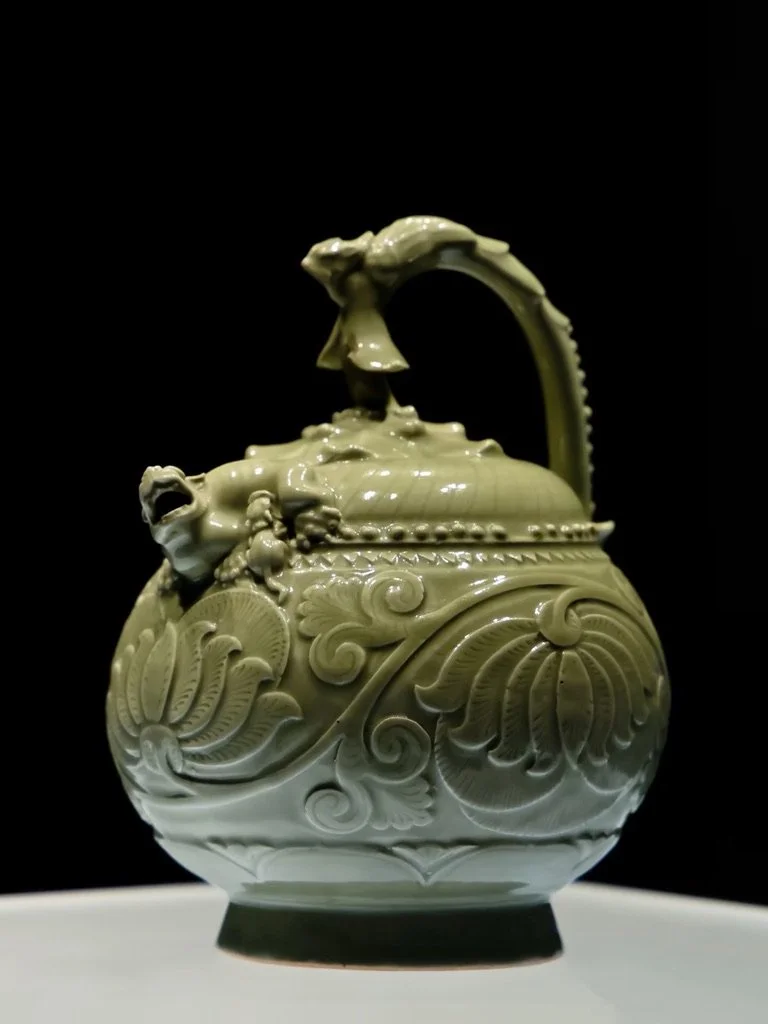
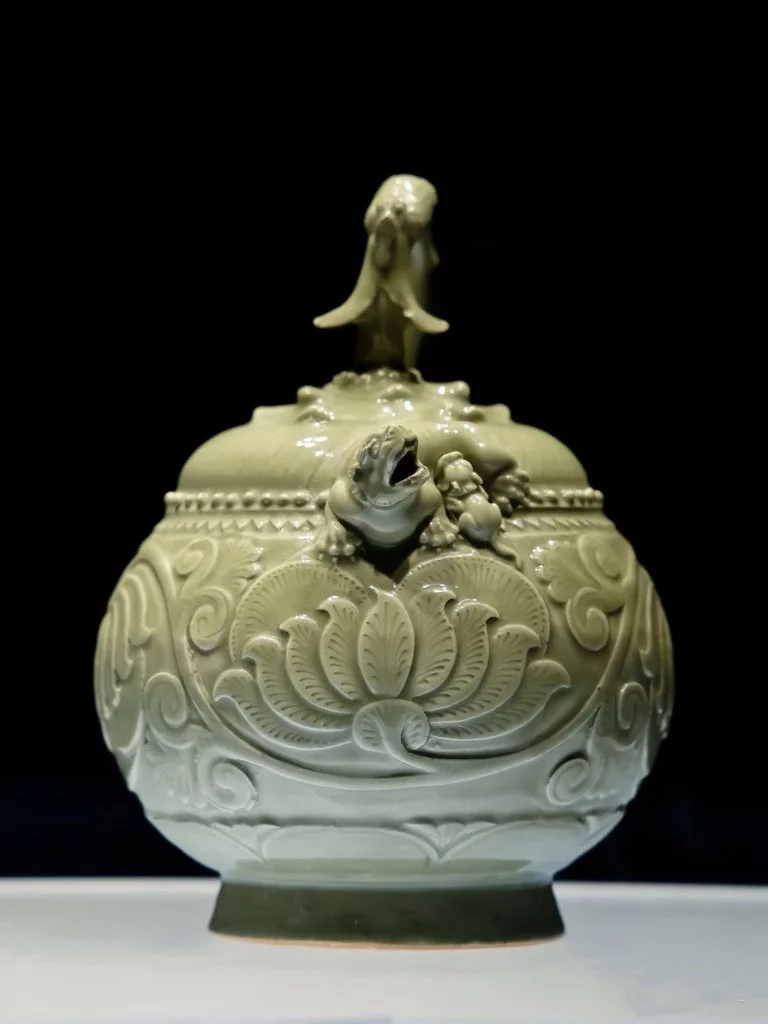
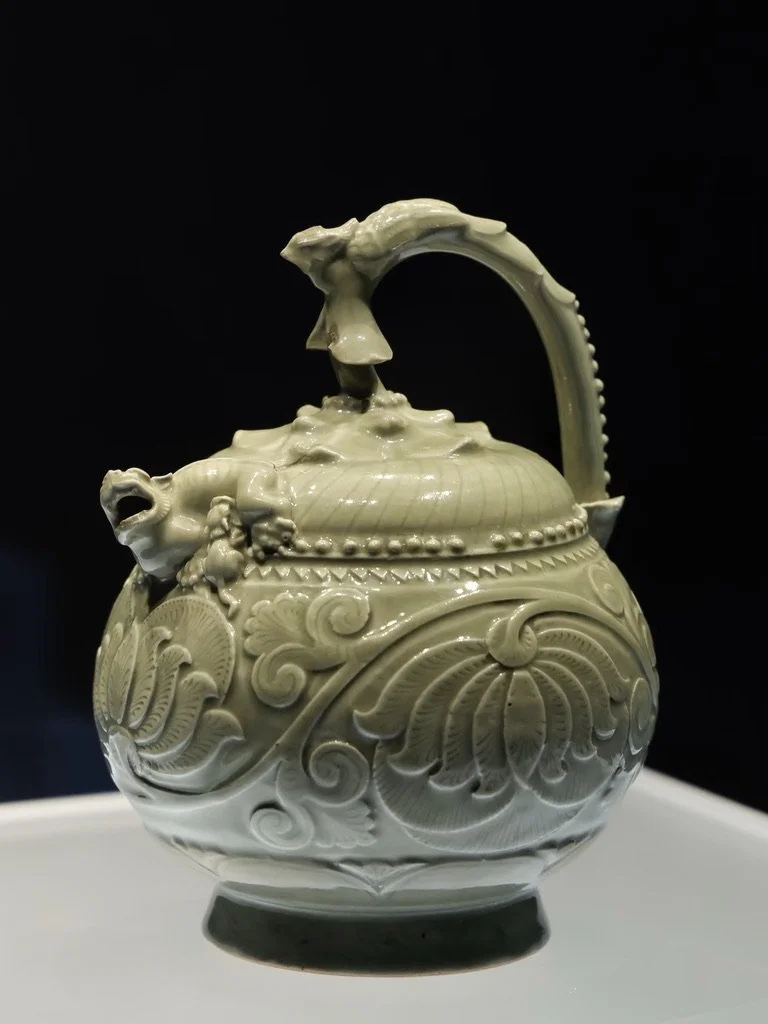
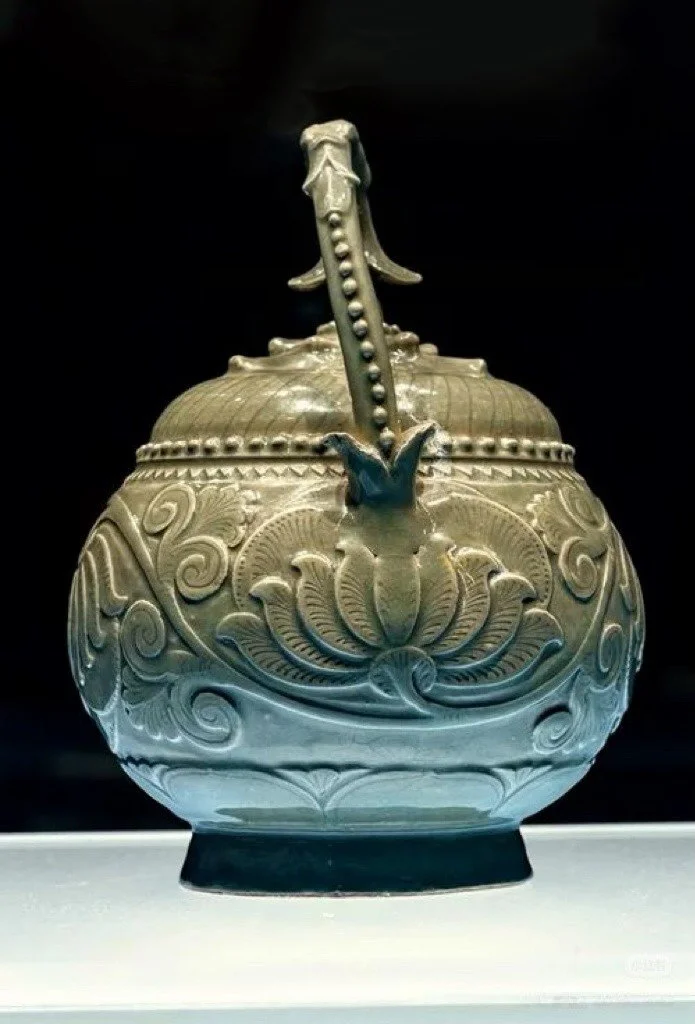
At first glance, this appears to be an extraordinarily elaborate celadon ewer.
A phoenix arches across the top to form its handle. A mother lion and cub emerge from the shoulder, while great peony blossoms unfurl across the rounded body beneath a translucent green glaze.
But something essential seems to be missing.
There is no conventional opening through which to fill it.
What appears to be the lid cannot be removed. It is permanently joined to the body of the vessel. Yet the ewer was designed to contain and pour liquid.
The answer lies somewhere few would think to look:
underneath the vessel.
Dating to the Five Dynasties period (907–960), this remarkable green-glazed reverse-filling ewer is preserved in the collection of the Shaanxi History Museum. The museum describes it as an exceptional product of the Yaozhou ceramic tradition, with a phoenix-shaped handle, mother-and-cub lion spout, scrolling peonies and a plum-blossom-shaped filling aperture concealed in its base.
A Vessel Filled from Below
The unusual construction becomes apparent when the ewer is examined from underneath.
At the centre of the base is a small plum-blossom-shaped aperture. To fill the vessel, the ewer is turned upside down and liquid is poured through this opening. Once filled, it is returned to its normal upright position.
Remarkably, the liquid does not simply pour back out through the hole.
Instead, it remains inside and can be poured normally through the lion-shaped spout.
This ingenious arrangement explains the name by which vessels of this type are now generally known: 倒灌壺, a “reverse-filling” or “bottom-filled” ewer.
How does it work?
The secret is hidden inside the vessel.
The bottom aperture communicates with an internal hollow tube extending upwards into the body. When the vessel is returned upright, the opening of this tube sits above the level of the liquid, preventing the contents from escaping through the base.
A separate internal passage communicates with the spout.
The system relies upon the behaviour of liquid in communicating vessels (連通器). Comparable surviving reverse-filling vessels demonstrate how potters used carefully positioned internal tubes to control both filling and pouring without requiring a removable lid. The Palace Museum describes the same hydraulic principle in a later Qingbai reverse-filling ewer from Jingdezhen.
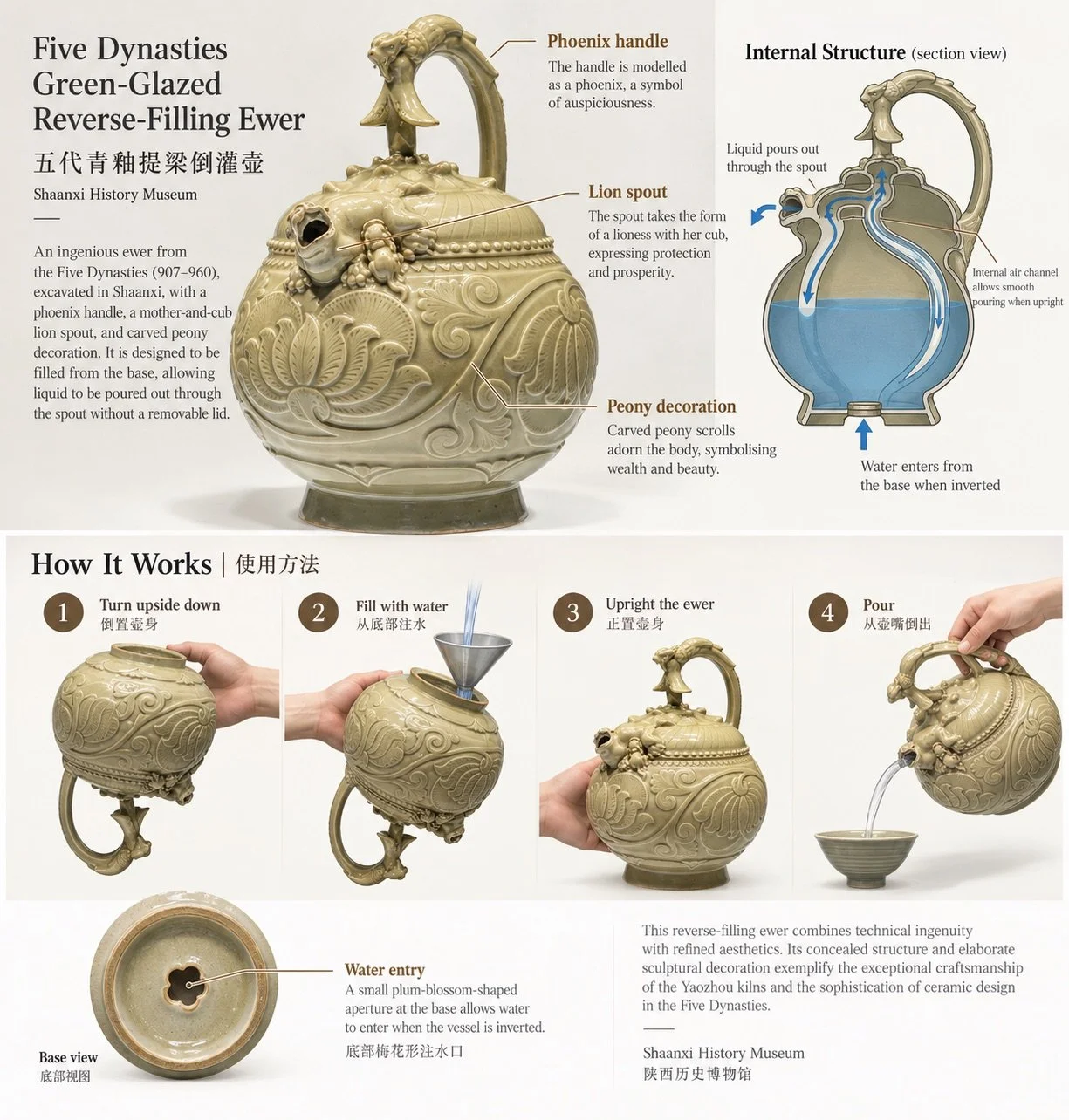
How the reverse-filling mechanism works: the vessel is inverted, liquid enters through the aperture in the base, and the internal tube prevents it from escaping once the ewer is returned upright.
The Yaozhou Kilns
The ewer belongs to the tradition of the Yaozhou kilns 耀州窯, one of the most celebrated centres of northern Chinese celadon production.
The principal kiln complex was situated around Huangbaozhen 黃堡鎮 in present-day Tongchuan, Shaanxi. Ceramic production there began during the Tang dynasty and continued for centuries. During the Song, Yaozhou became particularly renowned for celadons decorated with vigorously carved and moulded designs beneath lustrous olive and yellow-green glazes.
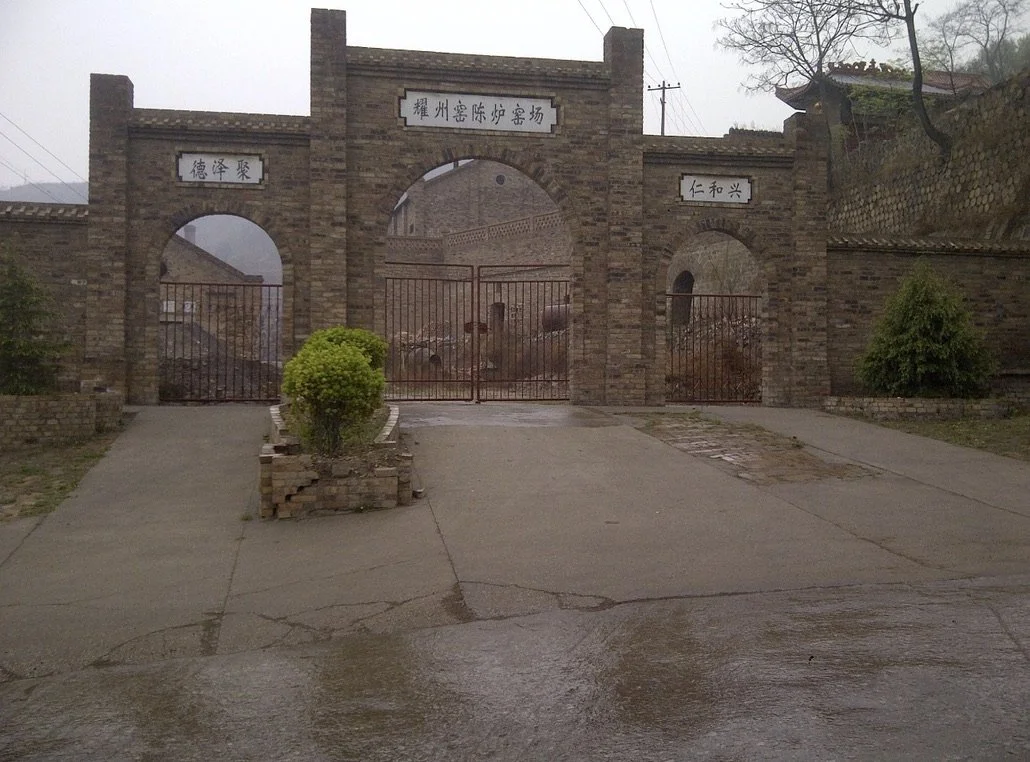
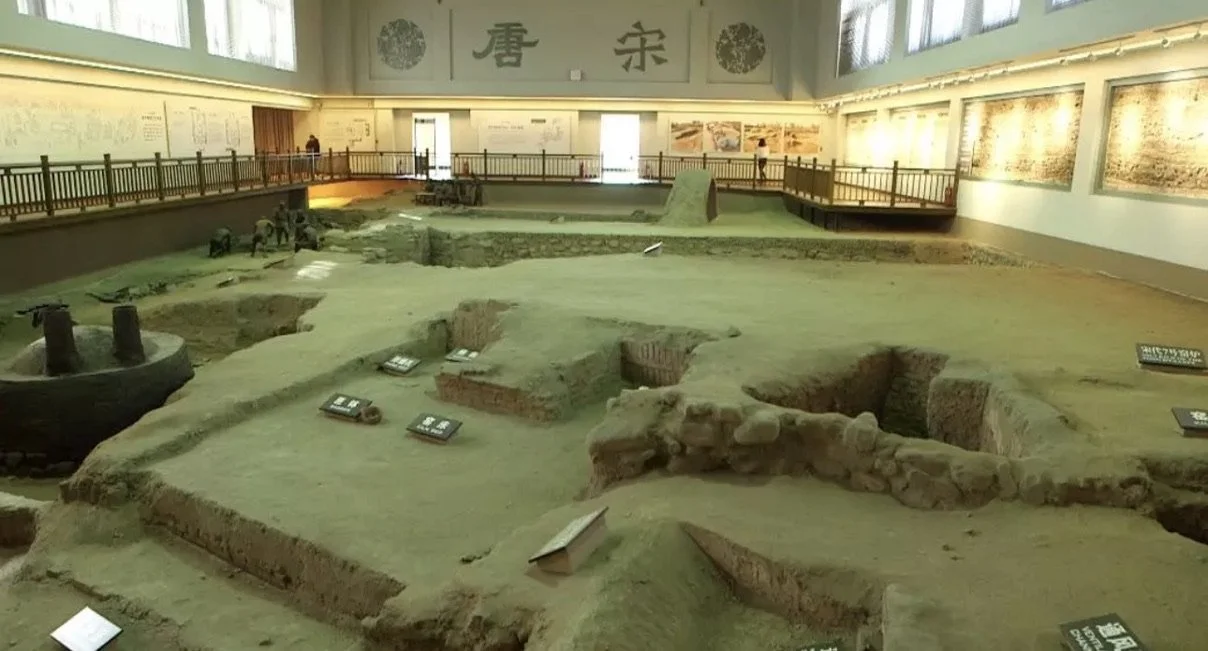
The historic Yaozhou kiln complex at Huangbaozhen, Tongchuan, Shaanxi.
The Five Dynasties period occupies an especially fascinating position in this history. Lasting only from 907 to 960, it separated the collapse of the Tang dynasty from the establishment of the Northern Song.
Yet artistically, it was far more than an interval between two greater dynasties.
Ceramic production continued to evolve, and Yaozhou wares of this period help reveal the experimentation that would eventually contribute to the extraordinary sophistication of northern celadon during the Song.
Phoenix, Lions and Peonies
Engineering alone, however, does not explain why the potter made the vessel look like this.
Almost every functional element has been transformed into an image.
The handle becomes a phoenix.
Rather than attaching a simple loop, the potter modelled the handle as a recumbent phoenix sweeping across the top of the vessel. Beneath it, a floral element creates the appearance of a conventional lid knob even though the upper section is sealed.
At the opposite side is an even more unusual sculptural group: a mother lion nursing her cub. The mother's open mouth forms the spout itself. What could have remained a purely functional outlet has therefore been transformed into a miniature sculpture.
Across the globular body spread luxuriant scrolling peonies.
Rather than being painted onto the surface, the decoration is carved into the ceramic body beneath the glaze. As light passes through the translucent green glaze, it gathers more densely within the deeper recesses of the carving, accentuating petals, leaves and scrolling stems.
This relationship between carved surface and glaze would become one of the defining visual characteristics of mature Yaozhou celadon. The National Museum of China describes Song Yaozhou ware as particularly celebrated for its carved and impressed decoration, executed with fluid, vigorous lines beneath olive-green and yellow-green glazes.
An Ancient Piece of Hydraulic Engineering
What makes the ewer particularly compelling is that its technical sophistication is almost entirely concealed.
From the exterior, we see sculpture, carving and glaze.
Inside is a carefully planned hydraulic system.
Bottom-filled vessels were not unique to this particular ewer. Art historian Hsieh Ming-liang 謝明良 has examined the wider history of ceramic 倒灌壺 and notes that archaeological evidence indicates that Chinese kilns were producing vessels based on this principle by at least the ninth century, during the late Tang. The tradition subsequently continued through the Song, Liao, Jin, Ming and Qing periods and even appeared in Chinese export ceramics sent to Europe in the seventeenth century.
This changes how we understand the Shaanxi ewer.
Rather than being merely an isolated ceramic curiosity, it belongs to a much longer history of experimentation with vessel construction and the controlled movement of liquids.
Yet few surviving examples unite that technical ingenuity with such elaborate sculptural decoration.
From Tang Experimentation to Song Refinement
The ewer also captures an important moment in the development of Chinese ceramics.
Its elaborate phoenix, lions and luxuriant peonies retain something of the visual richness associated with late Tang and Five Dynasties decorative culture.
At the same time, its monochrome green glaze and increasingly sophisticated relationship between carved decoration and translucent glaze point towards the aesthetic language that Yaozhou potters would develop more fully during the Northern Song.
By the Song dynasty, Yaozhou celadon had become renowned for precisely this combination: controlled vessel forms, vigorous carved decoration and luminous green glaze. Contemporary and later sources recognised the quality of its production; an inscription erected at Huangbao in 1084 famously praised the local ceramics for craftsmanship comparable to worked metal and carved jade.
Seen in this context, the reverse-filling ewer is not simply an ingenious novelty.
It stands at the intersection of late Tang experimentation and Song refinement.
The Secret Beneath the Vessel
Seen in the museum case, the ewer initially demands attention because of its decoration.
The phoenix is immediately visible. So are the lions and the great scrolling peonies.
But its most extraordinary feature is almost completely hidden.
At the centre of the base is a small plum-blossom-shaped opening, the entrance to an internal system that transforms the way the entire vessel functions. The Shaanxi History Museum still displays the ewer today as part of its permanent Ancient Civilisation of Shaanxi exhibition.
That inversion is what makes the vessel so memorable.
Its most spectacular features are visible on the outside, but its greatest technical surprise lies within.
More than a thousand years ago, a Yaozhou potter brought together sculpture, carving, glazing and hydraulic design within a single ceramic vessel.
To understand how it works, we have to do exactly what its original owner did: turn the vessel upside down.
References & Further Reading
Shaanxi History Museum, “Five Dynasties Green-Glazed Handled Reverse-Filling Ewer / 五代青釉提梁倒灌壺.” This should be your primary object citation.
Shaanxi History Museum collection record
National Museum of China, “Yaozhou Ware Celadon Tripod Censer with Carved Lotus-Petal and Scroll Designs / 耀州窯青釉刻蓮瓣卷草紋雙耳三足爐.” Particularly useful for the history and characteristics of the Yaozhou kiln complex.
National Museum of China: Yaozhou ware
Hsieh Ming-liang 謝明良, “On Ceramic Dao Guan Hu (Bottom-filled Ewer) / 關於陶瓷倒灌壺,” Art History / 美術史學研究, no. 310 (2021), pp. 77–101, DOI 10.31065/kjah.310.202106.003. This is the most useful academic reference for the mechanism and broader history of this vessel type.
Academic article record and abstract
National Palace Museum, “The Scientific Principles in Cultural Objects: Taking Reverse-Filling Ewers as an Example / 文物中的科學原理——以倒流壺為例.” Particularly useful because it includes comparative typology and diagrams of the internal mechanism.
National Palace Museum research article
Palace Museum, Beijing, “Jingdezhen Ware Qingbai-Glazed Reverse-Filling Ewer / 景德鎮窯青白釉倒流壺.” Useful as a later comparative example explaining the communicating-vessel mechanism.
Palace Museum collection record
