NEOLITHIC
新石器時代
HAN
漢
NORTHERN DYNASTIES
魏晉南北朝
SUI
隋
TANG
唐
SONG
宋
YUAN
元
MING
明
QING
清
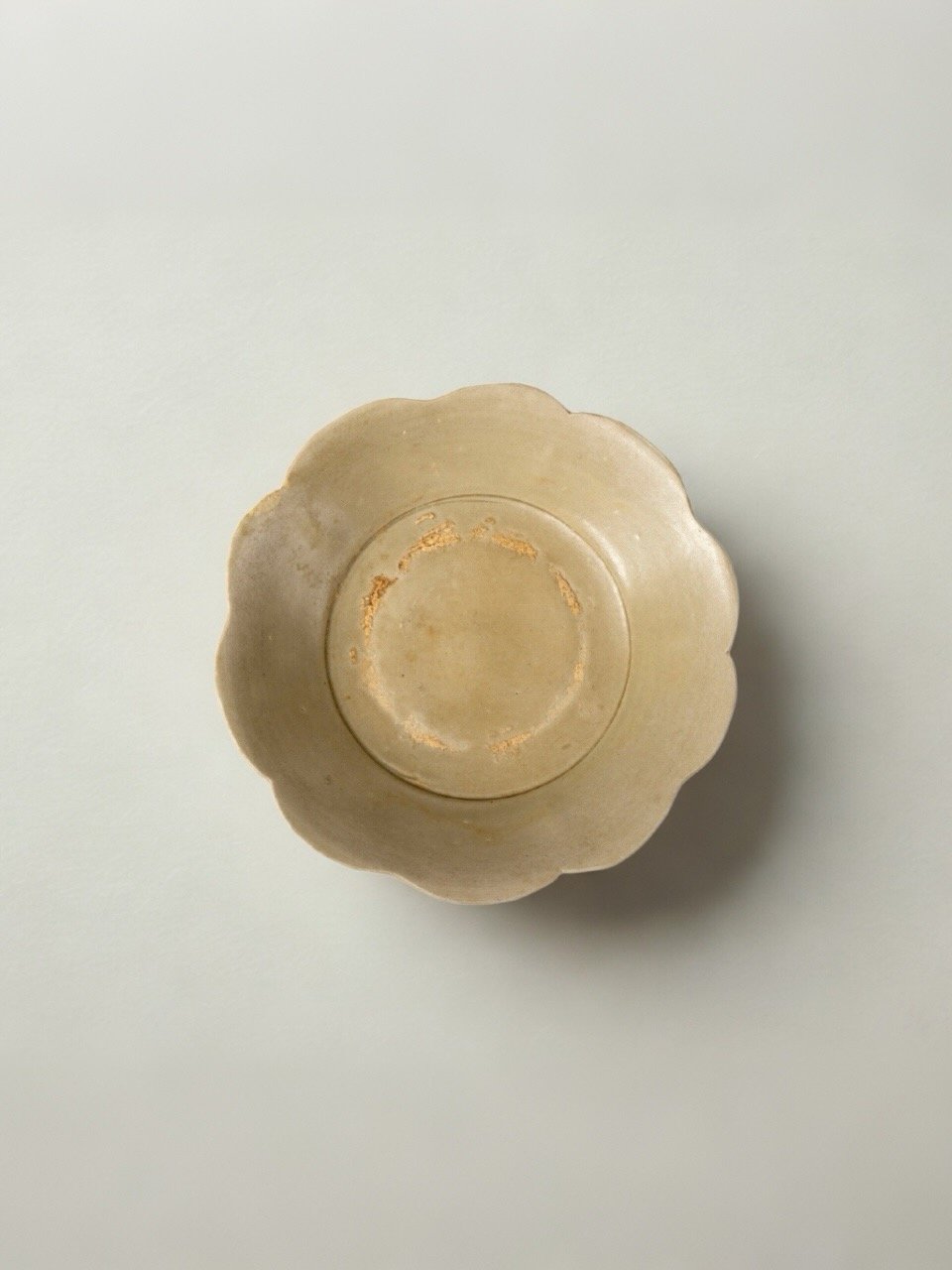
This elegant Yue ware foliate dish is a refined example of celadon production from the Five Dynasties period, a time when Yue kilns of Zhejiang province produced some of the most admired green-glazed ceramics in China. The dish is delicately potted with softly lobed foliate sides, its restrained form embodying the understated aesthetic associated with early Yue celadon.
Covered in a smooth olive-green glaze of gentle, jade-like tone, the surface possesses the quiet luminosity and subtle refinement that made Yue wares highly prized during the late Tang and Five Dynasties periods. The thinly applied glaze reveals the fine pale body beneath in places around the foot rim, while the softly undulating floral outline lends the vessel an elegant sculptural rhythm.
The simplicity of the form, combined with the purity of glaze and proportion, reflects the sophisticated ceramic ideals that would profoundly influence later Song dynasty aesthetics. Yue celadons of this type were celebrated for their restrained beauty and technical precision, representing an important stage in the development of monochrome Chinese ceramics.
Diameter: 16 cm.
Provenance:
Private Taiwanese collection.
Exhibited:
Splendor of China – Song and Yuan Porcelain, National Museum of History, Taipei, 2008.
Published:
Cheng Qiren, Splendor of China – Song and Yuan Porcelain, Taipei: National Museum of History, 2008, catalogue no. 17, exhibition no. 153, pp. 54–55.
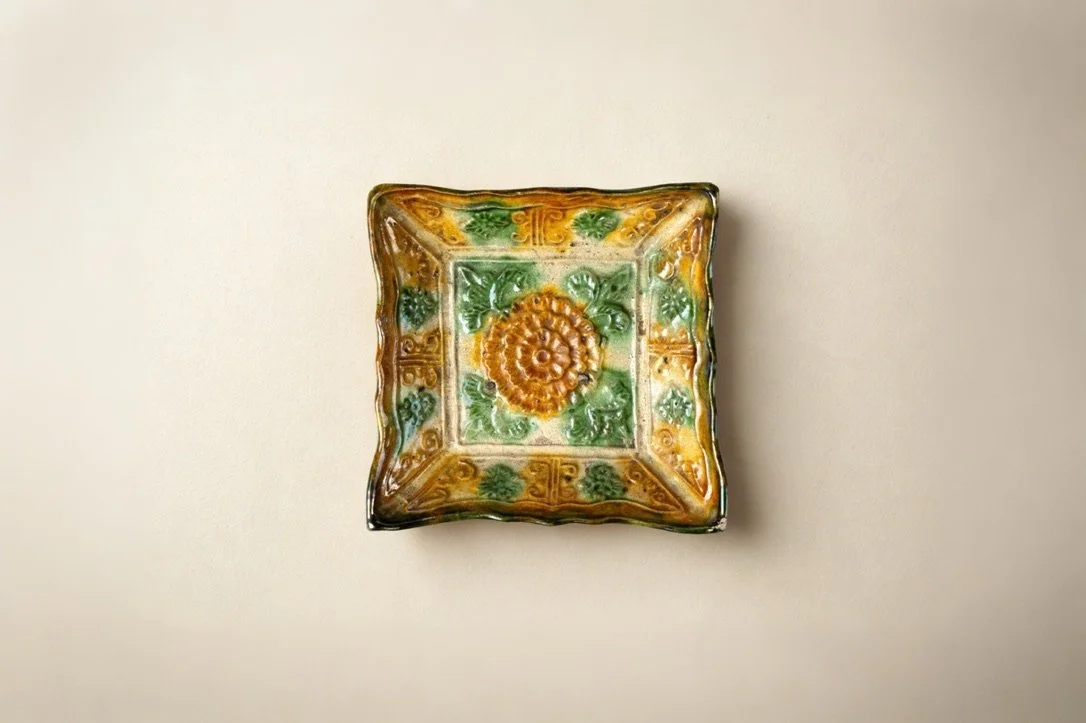
This finely moulded Liao dynasty sancai-glazed dish is a rare and elegant example of northern Chinese ceramic production during the Khitan Liao period. Of square form with gently barbed sides, the dish is richly decorated in amber, green, and cream sancai glazes, the luminous colours pooling attractively within the moulded contours of the design.
At the centre is a raised floral medallion surrounded by stylised foliate motifs framed within geometric compartments, all rendered in high relief with remarkable clarity and vitality. The softly undulating rim further enhances the sculptural quality of the piece, while the contrasting sancai glazes create a vivid interplay of colour and texture characteristic of Liao ceramic aesthetics.
The dish reflects the continued development of Tang sancai traditions in northern China, interpreted through the bold decorative vocabulary and robust modelling associated with Liao dynasty ceramics. Pieces of this type are admired for their lively glazing effects, architectural symmetry, and strong ornamental presence.
Width: 12.6 cm.
Provenance:
Private Taiwanese collection.
Exhibited:
Good Fortune Throughout History: Black Glaze and Porcelain from Tzu-chou and Ji-chou Kilns, National Museum of History, Taipei, 2004, exhibition no. Zhan 146.
Published:
Cheng Qiren, Good Fortune Throughout History: Black Glaze and Porcelain from Tzu-chou and Ji-chou Kilns, Taipei: National Museum of History, 2004, catalogue no. 146, p. 21.
Exhibited: The National Museum of History, Taipei, 2008
Published: Cheng Qiren, 玉潤玄光 : 宋元名窯瓷器展 (Splendor of China- Song and Yuan Porcelain), The National Museum of History, Taipei, 2008, catalogue no. 49, exhibition no. 440, pp. 126
來源
洪敏昌先生舊藏
展覽:「玉潤玄光:宋元名窯瓷器展」,國立歷史博物館,中國台北,2008。
著錄:成耆仁著:《玉潤玄光:宋元名窯瓷器展》,中國台北:國立歷史博物館,2008,圖版49,展覽編號440,頁126
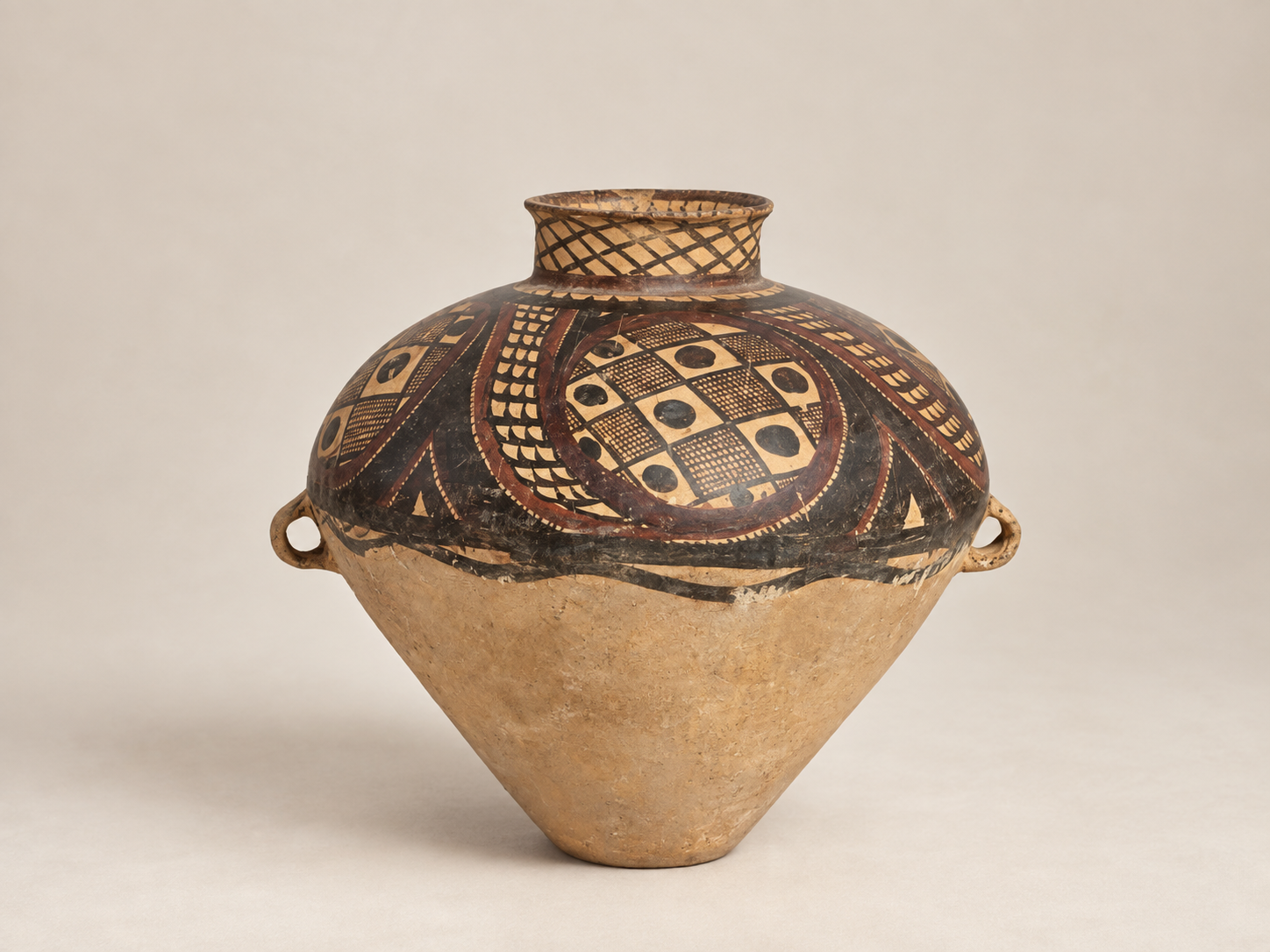
A large and visually striking painted pottery jar from the Banshan phase of the Majiayao culture, standing 45 cm in height and 52 cm in width. The vessel is robustly potted with a broad, rounded shoulder tapering elegantly to a narrower base, topped by a short neck with a slightly everted rim. A pair of small loop handles is applied at the shoulder, enhancing both its functionality and visual balance.
The decoration is conceived to be appreciated from a top-down perspective, a characteristic feature of Banshan pottery. When viewed from above, the composition reveals a carefully balanced arrangement of circular medallions and radiating geometric motifs. These medallions, filled with lattice grids, dots, and cross-hatched patterns, are interconnected by sweeping curved bands that create a dynamic sense of rotation and visual rhythm across the surface.
Such geometric designs are widely understood to carry symbolic as well as decorative meaning. The circular motifs may evoke celestial bodies such as the sun, while the repeated dot patterns can suggest seeds, fertility, or cycles of life. The interlocking grids and net-like patterns are often interpreted as representations of order, structure, or early cosmological concepts—reflecting a worldview in which harmony between natural and spiritual realms was essential. The swirling arrangement further enhances this impression, suggesting movement, transformation, and cyclical time.
The upper body is richly ornamented in deep brown to black mineral pigments over a warm buff ground, the painted decoration remaining vibrant and visually compelling. The lower body is intentionally left plain, creating a refined contrast that grounds the composition and accentuates the complexity above.
The jar is in exceptional condition for its great age, as can clearly be seen in the images above. There are the expected traces of burial accretions, contributing to its authenticity, while surface wear is minimal. There is no evidence whatsoever of restoration or repair, and the original painted decoration is beautifully preserved throughout. Simply stunning, a true masterpiece.
A powerful and scholarly example of Banshan painted pottery, notable not only for its impressive scale and remarkable state of preservation, but also for its sophisticated design and profound symbolic resonance.
Provenance:
Private Collection, Greenwich, Connecticut
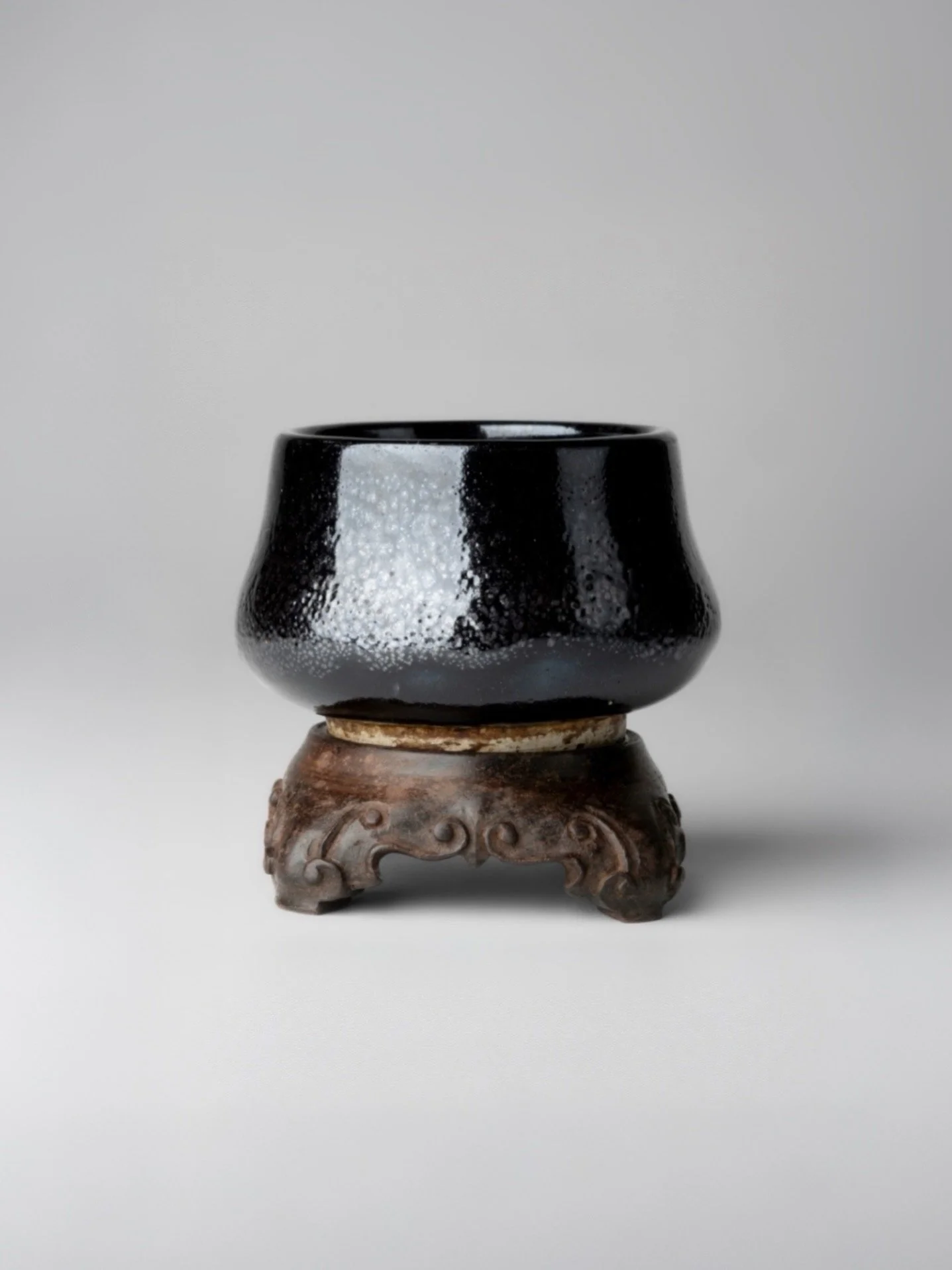
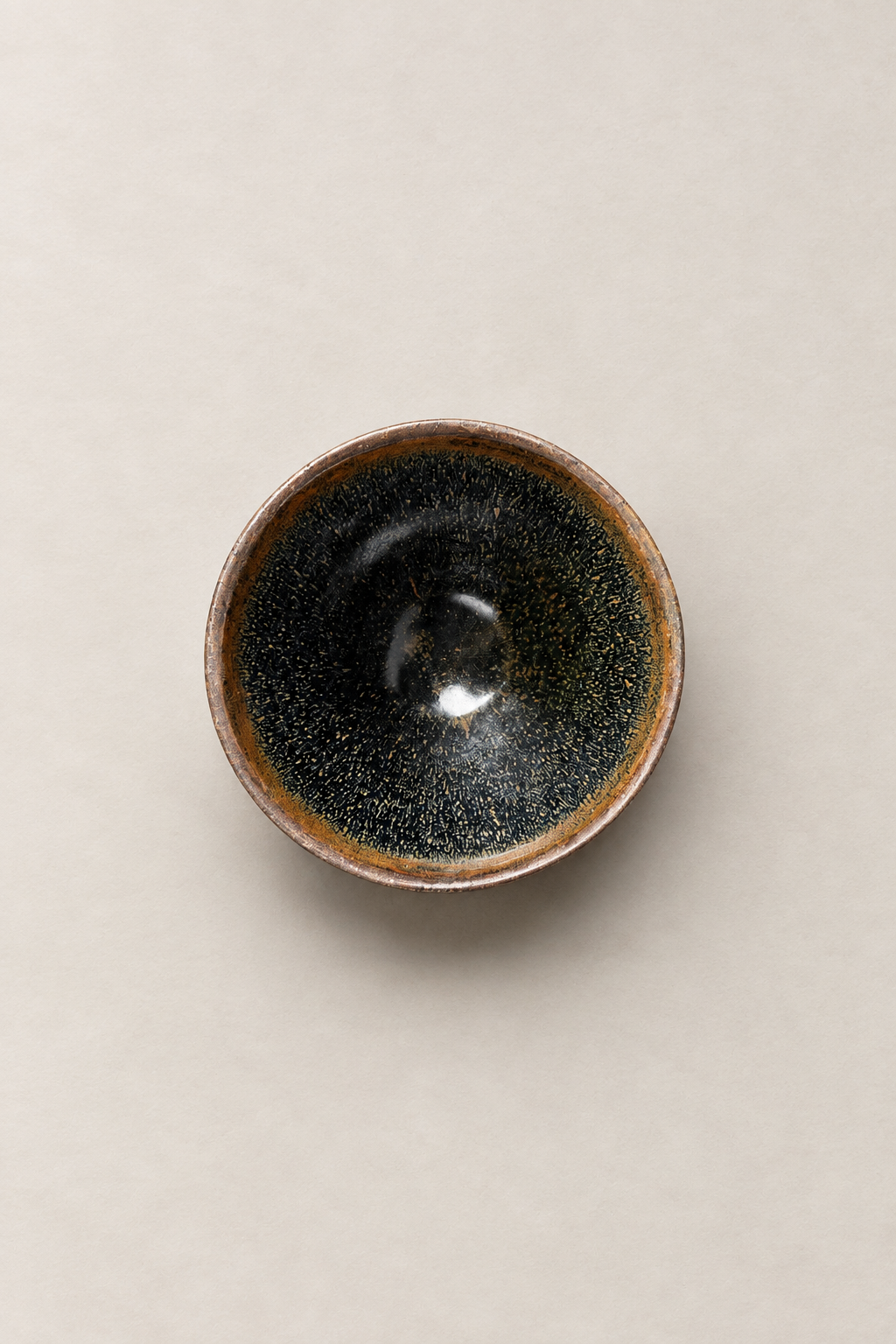
This finely potted black-glazed cup is a striking example of Yuan dynasty Cizhou-type stoneware, notable for its lustrous oil-spot glaze and bold sculptural form. The vessel has a rounded compressed body rising to a gently flared rim, its elegant silhouette enhanced by the thick, richly textured black glaze covering the exterior and interior surfaces.
The glaze displays an attractive oil-spot effect, created through the complex interaction of iron-rich glaze and kiln atmosphere during high-temperature firing. Across the glossy black surface appear countless silvery metallic speckles that shimmer subtly under light, recalling the appearance of scattered oil droplets. This distinctive effect reflects the technical sophistication and experimental spirit of northern Chinese kilns during the Yuan dynasty.
The slightly uneven, hammered-like glaze texture further enhances the tactile quality of the piece, while the exposed foot reveals the pale buff stoneware body beneath. Black-glazed wares of this type were admired for their dramatic visual contrast, robust forms, and rich glaze effects, embodying the powerful aesthetic associated with Yuan dynasty ceramics.
Displayed here upon a carved wooden stand, the cup possesses a quiet yet commanding presence, combining simplicity of form with the dynamic beauty of its oil-spot glaze.
Width: 8.5 cm.
Height: 5.5 cm.
Provenance:
Private Taiwanese collection.
Exhibited:
Splendor of China – Song and Yuan Porcelain, National Museum of History, Taipei, 2008.
Published:
Cheng Qiren, Splendor of China – Song and Yuan Porcelain, Taipei: National Museum of History, 2008, catalogue no. 54, exhibition no. 138, pp. 138–139.
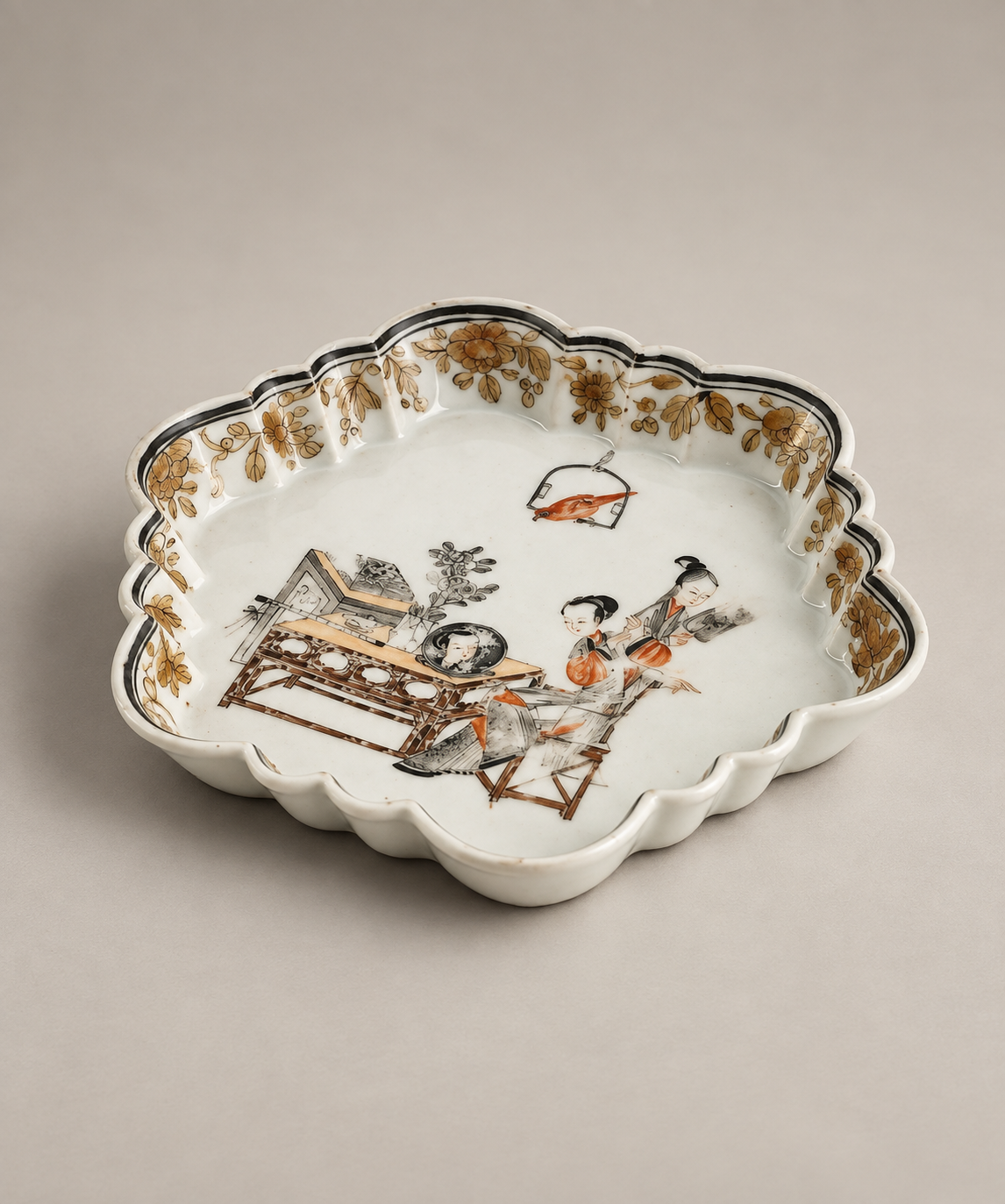
This refined grisaille porcelain dish from the Qianlong period (1736–1795) exemplifies the delicate artistry of 18th-century Qing dynasty export porcelain. Molded in a rare lobed or foliate shape, the dish features finely painted figural decoration in black enamel with iron-red and gilt highlights, a technique known as en grisaille with polychrome accents.
At the center, an elegant indoor scene unfolds: two finely dressed women are depicted at leisure in a furnished interior, surrounded by classic scholar’s objects such as books, potted plants, and a zitan-style table. The border is richly adorned with gilt floral sprays, complementing the restrained monochrome palette and enhancing the dish’s decorative appeal.
This type of Chinese export porcelain was highly prized in Europe for its refined detail, storytelling charm, and graceful composition. A superb example of Qianlong grisaille ware, it reflects both imperial craftsmanship and the global reach of 18th-century Chinese ceramics.
Height: 13.5cm
Provenance: Collection of Antique Dealer Graham Salter
此件精緻的清乾隆時期(1736–1795)黑釉描金瓷盤,展現十八世紀清代外銷瓷器藝術之高超工藝與雅緻格調。器形罕見,採葉形或花瓣式輪廓,盤面以黑釉(en grisaille)細緻繪製人物圖,並輔以鐵紅與金彩點綴,色調內斂而不失華美,技法獨特。
盤心描繪一幅典雅的室內生活場景:兩位身著華服的仕女悠然對坐於布置典雅的書齋之中,四周陳列有書籍、盆栽、紫檀風格書案等文人器物,突顯出清代士大夫階層的審美趣味與精神寄託。盤緣飾以描金花卉紋飾,與主圖構成精緻的視覺對比,增添器物的裝飾性。
此類帶有彩色點綴的黑釉外銷瓷,在十八世紀歐洲市場極為受歡迎,因其構圖細膩、情節生動,兼具敘事性與裝飾性。本品為乾隆時期描金黑釉瓷器之優秀範例,體現清代御窯製瓷技藝與中國陶瓷在全球藝術交流中的重要地位。
寬度:13.5公分
來源: 英國古董商Graham Salter 收藏
SELECTED WORK OF ART 精選藏品